Showing posts with label training. Show all posts

19 April 2012

IDF soldier collapses and dies during training


Wednesday was not a fun day for me. My son, the IDF Serviceman, was trying out for an elite IDF combat unit. Imagine hearing this on the radio all the while knowing that your son is there.

"An IDF serviceman died on Wednesday morning after collapsing during a training exercise at a southern army base on Wednesday morning. He collapsed on the final day of a grueling four-day trial in the Negev desert for entry to an elite IDF unit. Medics tried in vain to resuscitate him at the scene. He was evacuated to Yoseftal Hospital in Eilat, where he was pronounced dead.

The soldier reportedly collapsed while training near his fellow recruits. The head of emergency medicine at Yoseftal Hospital reports that he had suffered a heart attack that was most likely unpredictable — similar to the deaths of otherwise healthy athletes during sporting events.

The IDF Ground Forces command and the chief medical officer launched an investigation into the causes of the soldier’s death."


The IDF Spokesman later released his name. Godspeed Cpl. Joshua Chefetz.

Eventually my son called to let us know that he was ok.


My condolences to Cpl. Joshua Chefetz's family and thanks to G-d for keeping my son safe.

If you'd like to make a donation in memory of Cpl. Joshua Chefetz, please go here.


Search DOUBLETAPPER for related posts

تنسيق-الكليات-لعام سكس نيك كس

26 November 2010

IDF Infantry Instructors

The Israeli Infantry Corps is a corps in the IDF GOC Army Headquarters. It includes several regular and reserve service units and brigades which are operatively commanded by the IDF’s regional commands.


Regular service brigades

* The Golani Brigade (Northern Command).
* The Paratroopers Brigade (Central Command).
* The Nahal Brigade (Central Command).
* The Kfir Brigade (Central Command).
* The Givati Brigade (Southern Command).

Independent battalions

* The Sword Battalion (299th)
* The Desert Reconnaissance Battalion (585th)
* The Caracal Battalion (33rd), named after the Sand Cat

Independent units

* The Duvdevan unit
* The Maglan unit
* The Oketz unit (dog handlers).

Training

At the beginning of each basic training course, there are several days of 'integration', where drill instructors convert recruits from civilians to soldiers. These are usually considered the most difficult days of any basic training program, even though they are not physically draining. During these days, recruits receive no breaks and the discipline is at its highest level.


While and each Unit training varies, there are some share commonalities. All soldiers are issued weapons after their initial integration days and must carry them until the end of the basic training course. Many lessons are also common for all corps, such as moreshet krav (literally "battle heritage"), where soldiers are taught about historic IDF operations.  Most Infantry Units basic training course lasts four months.  Advanced training can last another 4 months.

Physical and verbal aggression are not permitted in the IDF basic training, which leaves drill instructors with a limited number of ways to hand out punishments. Physical punishments such as push-ups and running are common ways to punish for several discipline issues. Another method of punishment is giving detention - keeping a soldier several more days in the training base instead of weekend furlough; or simply delaying the visit home by a few hours. And group punishments, where if one soldier makes a mistake, the entire platoon suffers.


IDF Women as Infantry Instructors

تنسيق-الكليات-لعام سكس نيك كس

Search for related posts


http://DoubleTapper.blogspot.com

28 October 2010

IDF Graduates Largest Ever Medical Doctors Class

The IDF Medical Corps completed the largest medical course in IDF history. The IDF reported that 50 new medical doctors will graduate and be assigned to the various air, sea, and land IDF units.  The new doctors will be assigned to 35 different battalions, of which 17 never had a regular doctor, relying on a paramedic or temporary physician.

IDF MD Doctors Train under fire

The IDF’s Chief Medical Officer, Brigadier General Dr. Nachman Ash, credited an extensive campaign the IDF ran encouraging future soldiers to join the Medical Corps and other enticements that the IDF used to fill the IDF's need for new medical doctors.

Brigadier General Dr. Ash, who gave the IDF’s future doctors their final examination, congratulated them and said: “These are doctors who are fully motivated, they are ready and willing to perform their duty. There is no doubt that from now on, with all the IDF’s field units manned by doctors, the response to our soldiers will also improve accordingly.”


تنسيق-الكليات-لعام سكس نيك كس

Search for related posts


http://DoubleTapper.blogspot.com

04 February 2010

Israeli Security Training

Numerous Private Security Companies throughout Israel offer various training courses to Security Officers from around the world. Training Courses offered in Israel can last anywhere from a week to a month and cover all aspects of security training at all levels.

Security Training in Israel give security operators the chance to learn from Israeli experts from all branches of the IDF and Israel's security services. In addition, Trainees are exposed to Cutting edge Israeli security and weapons products, and techniques.

Here are some promotional videos and pictures

تنسيق-الكليات-لعام سكس نيك كس


Send me an email and let me know if you'd like more information on Security Courses and Training in Israel.

Search for related posts


http://DoubleTapper.blogspot.com


02 August 2009

Final March, an IDF recruit's story

تنسيق-الكليات-لعام سكس نيك كس

What's it like to hump over 50 lbs of gear at night,
in complete silence, with open stretchers ?
Why,
To what end?
Why


A friendly blood blister. Not me, thankfully.


The masa kumta (beret march, essentially) is the final hike in a long series of hikes that begin in the first month of basic training, and end, at least for certain infantry units, at the end of advanced training. That means that for the duration of your entire training period you have to face these marches. The purpose of a masa is clear: you do them in combat. Not every battle is found right outside your barrack's doors. Sometimes you've gotta hike a few miles out there, or a few back. Why do we open stretchers and load them up and hike miles and miles with them? Because at the end of most battles you've gotta get the wounded out, and there are always wounded. Of course, the masaot also build teamwork, esprit de corps, and give training a sort of backbone - not to mention a clear finale.

What is a masa? Two single file lines. Usually at night. Complete silence. Full gear (combat vest with all related equipment, personal gun, light machine gun, heavy machine gun, water packs, stretchers). Very fast pace (6 to 10 km/h). Steep inclines.

And what is the masa kumta? This is when you earn your brigade's beret, which is simply a different color from other brigades.

OK, is everything explained well? Good, so let's get personal now. You want to know what it was like? It sucked. Everyone was in agreement: it was twice as bad as the "machin masa kumta," which is the 'preparation masa' for the masa kumta. That means it was the one right before this final one. They were the same pace, of course same gear and all that, but the machin had more inclines, meaning it should have been much worse. However, I remember laughing and smiling and singing to myself the entire machin masa! It was good times! "ONLY ONE LEFT!," I thought happily.

The masa kumta, however, brought me no such joy. I don't think I even dreaded it. I don't think I was nervous or anything. I was ready to get it over with before we started, but I did want to do it. I often have thoughts like, "I wish I could just do this blacked out, wake up during the final two minutes for the joy of finishing, and that's it." But I wasn't thinking that about the masa kumta. I wanted to say I did it with a clear mind, suffered as necessary, and finished strong.

I don't know what to tell you, mainly because I don't know myself. Why was it so hard when it actually should have been easier than that machin? I have no idea. Strange. Despite the torture that this was, I am extremely proud of myself for stepping it up with the gear. You see, we have extra gear that we have to carry the entire march - stretchers and a water pack. The stretchers aren't anything but obnoxious to carry on your back, but the water pack... the water pack is tough.

The pack we have holds 11 one and a half liter bottles, I believe.* That's 16.5 liters according to my calculator. Now, according to the infinitely wise Internet, a liter of water weighs 2.2 pounds. So, let me crunch some numbers... 36 pounds. You may be thinking that that's not too bad, it's not 100 pounds, but you try humping 36 pounds at 8km/h for even one hour. Don't forget your gun and your combat vest loaded with ammo, either.

No one ever wants to grab the water pack. We switch off just about every hour, but it always takes a long time to get someone to grab it. Usually the uncomfortable silence of no one stepping forward ends with the commanders yelling at people, and then they grab it. I took the pack the second hour, then after an hour passed it off per routine. Long story short, I was carrying the water again closer to the end, once we had opened the stretchers, despite there being numerous people that hadn't had the joy of lugging it. For the next nearly three hours I had it. No one offered to take the pack, and I didn't ask anyone to. That's 1 hour plus almost 3. Let's say 4 hours with the pack. Can't complain, though - I'm not the MAGist (heavy machine gunner).

For 7 months I dreaded masaot because of that pack, so I wanted to finish strong, with the water pack on my back, and the stretcher on a shoulder. There were guys in the back stumbling along, just trying to keep up, but about 10 of us were giving 100% so we could say we finished with everything we had. Waterpack on my back, stretcher on a shoulder, we ran to the finish line, a full sprint. I thought I was going to fall, but we went right on through to the end - 100%.

That's how you finish this crap.

How did I feel? Anti-climatic. I wasn't tired at all, like most of the guys. They were sleepy, but I don't know, I just kinda felt like I had something to do. I finished everything, the final step in the final masa had been taken, but there I stood. What next

More at Danny's blog

Search for related posts


http://DoubleTapper.blogspot.com


14 April 2009

IDF Riddle

تنسيق-الكليات-لعام سكس نيك كس
What happens when the IDF marches you with full gear carrying open stretchers through knee deep water and mud?

Your socks tend to get wet...


Wet socks are not good for your feet!


More here

http://DoubleTapper.blogspot.com


22 March 2009

IDF Field Training Golani Infantry 12th Battalion

Although I can still fell the soreness in my muscles, taste the crap they tried to feed us, and vividly recall the sadistic behaviour of our instructors, it's been a while since I was in Basic Training, but as I hear from the younger IDF servicemen, nothing has changed. The rain gear the IDF issues is ok if you are just standing guard, but when 1/3 of the annual rainfall comes down in less then a week, you might as well leave it at home!

http://www.fototime.com/B2703BE97C07BF9/standard.jpg

From another IDF Blogger in training on a typical winter day in Israel with IDF Golani Infantry, 12th Battalion:


Mud was in everything. The tents were solid brown, and we were rolling them up and sticking them in our assault packs with mud oozing out like the pack was filled with the stuff. It was plain gross, but I thought it was pretty fun, in a strange way. I felt like I was “doing it,” suffering for a greater cause. I felt productive. I felt like a soldier.

We were just throwing all this gear, the entire company was, into a 12x12 tent, something of that size. It was one big slime fest. Moving on here, we then were given the green light, room by room, to go to the officers’ tent and vote. You see, it was national elections day, a tightly polled race between Livni (Kadima) and Netanyahu (Likud). I was pretty excited to vote, maybe even as much as I was to be going back to base.

We stood in line outside of the tent, everyone secretly grabbing the avocados and fruits that the officers obviously weren’t going to eat; they were being drowned in a half-melted cardboard box outside. Finally, we were called in. I stepped into the tent not knowing what to expect, and was surprised to find a massively crowded scene. The 15x15 or so tent was packed with all types of commanders and officers I hadn’t seen all week. I suppose they were hiding from the rain. They all were sardined into the dimly lit shelter between tall stacks of food, gear, tables, and boxes. Boxes of who knows what. Just towers of brown boxes.

A single light bulb barely as bright as that old flashlight in your glove box hung over a plastic table where some army logistics guys, who I didn’t even see come to our camp, were handling paperwork and calling out our names. Next to them was a large cardboard presentation board, which was sitting on another table.

I signed a sheet with my name on it and was directed to behind the presentation board. Behind the board was a large tray with what looked like a hundred slots, all filled with different little slips of paper bearing political parties’ trademarks. I couldn’t remember what the symbol was for the party I wanted, and I could barely see, and the commanders were really hurrying everyone along, so eventually I just asked the guy on the other side to help me. He was actually really nice, considering the conditions, and he showed me what I requested. I took that sheet, put it into another envelope, carefully wrote my info on the outside, and dropped it into the big blue voting box, effectively becoming a true citizen-soldier. Another integration into this state; one more little step on the path of taking my claim to this country.

But before I could process the implications of my civic involvement in Israel, I was ordered to briskly make my way outside to eat. They threw a soaked box of combat rations to us and we quickly dug in. The rain was only coming down in a drizzle, but we all were waiting for another big deluge.

After maybe 10 minutes, the platoon commander came over and told us to pack it up and get our vests on. We kinda hesitated for 5 seconds, and then he yelled, “UP, NOW! I don’t care if you’ve got a fork in your mouth, spit it out and GO!” [Nearly verbatim]. We jumped up, me swallowing a large last bite of tuna and chocolate spread on soggy bread.

We went over to our vests and assault packs, which were next to piles of sleeping bags and all types of heavily mud caked gear. We were then commanded to take all the sleeping bags and move them about 10 feet away, as well as plastic rain guards for the tents. Because everything was soaked with mud and rain, each thing was three times the weight. A single Jeep’s headlights were slantingly lighting the mayhem going on, and I can’t even begin to tell you the apprehension I felt.


I knew what was about to happen. I looked around and saw all the gear we came in with, the stretcher piled high with our huge ‘kitbags,’ (dufflebags), wooden boxes of commanders’ gear, assault packs, water packs, ammo, etc. After some yelling, and a frantic search for someone’s gun lost in the midst of all this stuff, we loaded up. We had to hike the few kilometers in the mud to the road we came from, which was up a steep hill...

More here

تنسيق-الكليات-لعام سكس نيك كس

Search for related posts


http://DoubleTapper.blogspot.com

03 December 2008

IDF Sniper Training


تنسيق-الكليات-لعام سكس نيك كس
IDF Snipers are indoctrinated in one of three courses:

  1. Four week basic snipers course for infantry units.
  2. Three week basic snipers course for Special Forces units’ personal.
  3. .50 caliber shooting course.

The two basic snipers corses are identical in content. Most of the SF sniper course’s graduates will proceed to a three week CT/HRT sniper course.

The IDF’s sniper school course teaches the basics of sniping and focus on long range, open field combat, infantry style shooting (up to 800 meters).


The 50 caliber sniper course is a separate course. Course’s graduates are only qualified on the Barrett 82A1. The Barrett's main use in the IDF is for Hard (light armored) Target Interdiction (HTI) shooting, and not for extreme range sniping. The Barrett is basically used as a very accurate heavy fire support, to take out Armored Caring Vehicles (acv), jeeps, cars, and to shoot through walls, etc.

The IDF utilizes its infantry snipers in a ‘designated marksman’ role- meaning that the sniper is equipped with longer range rifle, scope and a bi-pod and will help the advancing infantry force with short-medium range fire support- rather then a super long range shooter hundreds meters away waiting for a target to pass his cross-hairs.


The IDF is moving towards complete separation of the two roles. The snipers are beginning to move from the platoon level to the company and even to battalion level, in ‘all sniper’ squads.


The IDF designated marksmen engage targets up to 500 meters with rapid and accurate fire support , while the snipers engage targets found at longer ranges, up to 800 meters.


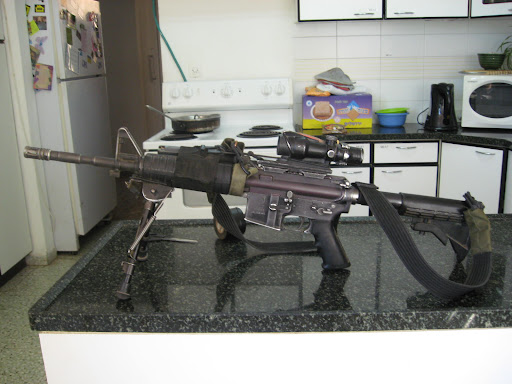
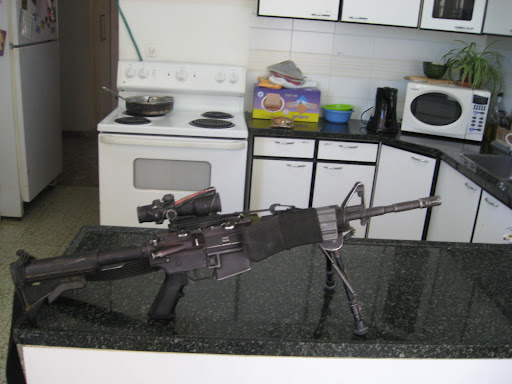
The IDF infantry designated marksmen use the M4 with an upgraded match barrel, Harris bipod and Trigicon 4x32 ACOG™ (Advanced Combat Optical Gunsight) scope.

IDF Marksman M4 in Mrs. DoubleTapper's kitchen


The Trigicon ACOG gives you the fast target acquisition, huge exit pupil and long eye relief of a red dot scope without any worry of a battery failing, because there isn't one! The revolutionary dual-illumination tritium / fiber optic lamp gives you brilliant, self-adjusting illumination in any light conditions.


  • 4X magnification and 32 mm objective lens aids in detecting partially hidden targets out to 300m... FOV: 36.8 ft. @100 yds.
  • Red-colored Chevron reticle with 800 m bullet drop compensator calibrated for .223 from the 20" M16A4 barrel
  • Broad band anti-reflective multi-coated lenses for superior clarity and light gathering with zero distortion
  • Bindon Aiming Concept™ (BAC) allows you to sightwith both eyes open for rapid target acquisition and maximum situational awareness all while still taking full advantage of 4X magnification
  • Internally adjustable and tough... only the prism housing moves making the ACOG more rugged than conventional designs
  • Longer 1.5" eye-relief for larger caliber rifles, larger 8 mm exit pupil for faster target acquisition
  • Adjustment: 3 clicks per inch @ 100 yds.
  • Waterproof to 100 ft... dry nitrogen purged to minimize fogging
  • Military grade 7075-T6 aircraft aluminum alloy housing makes this system nearly indestructible


http://DoubleTapper.blogspot.com


Jews